


LinkedIn Ad Formats for B2B: A Full-Funnel Guide
Not all LinkedIn ad formats are built to convert, and that’s the point. This guide shows B2B marketers how each format actually works across the funnel, what to launch this week, and how to measure success without killing performance early.
Key Takeaways:
- LinkedIn is objective-based. What you’re charged for (the billable event) depends on the objective and optimisation you choosel, so the same format can behave very differently depending on setup.
- Not every format is built to convert. The single biggest cause of poor LinkedIn performance is forcing every format into the demand-capture bucket.
- Match the format to buyer readiness. Top-of-funnel formats build familiarity, mid-funnel formats educate, and bottom-funnel formats capture intent that already exists.
- If you could only run four formats, Thought Leader, Single Image, Document and Conversation ads cover the full funnel.
- Repeat your message longer than feels comfortable. Unlike Meta, you don’t need to rotate creative weekly, let a few clear ideas saturate your ICP (aim for ~80%+ audience penetration in 60 days).
- Validate cheaply before you spend big. Prove a message with text and image ads first; video and CTV are for amplifying what already works, not for testing.
- Use people before brands. Senior voices and experts earn trust at the top of the funnel; brand ads convert once credibility exists.
Table of contents
- Formats play different funnel roles
- LinkedIn Text Ads
- LinkedIn Single Image Ads
- LinkedIn Carousel Ads
- LinkedIn Video Ads
- LinkedIn Connected TV (CTV) Ads
- LinkedIn Document Ads
- Thought Leader Ads
- LinkedIn Sponsored Messaging
- LinkedIn Lead Gen Forms
- Event, Article & Newsletter Ads
- What the best B2B teams do differently
- FAQs
If you’re a B2B marketing leader, you don’t need another list of LinkedIn ad formats, spec sizes, and their “best practices” according to LinkedIn.
You need a usable answer to four questions:
- Where does each format sit in the funnel (in reality)?
- What’s the best practice that actually changes outcomes?
- What can we do this week to leverage the format properly?
- How do we measure it without killing good work too early?
This guide is built around that.
One important thing to note is that LinkedIn is objective-based. What you’re charged for depends on the objective and optimisation you choose (the “billable event”), so the same format can behave differently depending on setup.
LinkedIn Formats play different funnel roles
One thing to keep in mind is that not every LinkedIn ad format is designed to convert.
Some formats are built to:
- Keep your brand visible to the right companies
- Reinforce your point of view
- Educate buyers before they’re ready to talk to sales
- Capture demand once intent exists
- Most performance issues come from forcing everything into the last bucket.
If you treat LinkedIn like a pure performance channel and not a demand generation tool, then your ads will only speak to the 5% of people who are actively in market.
| Format | Best Funnel stage | Best for | Not for | What to measure |
|---|---|---|---|---|
| Text Ads | TopMid | Low-cost, always-on familiarity with your ICP | Conversion, or judging success on clicks | ICP reach & frequency |
| Single Image Ads | TopMid | Landing one sharp idea or point of view fast | Explaining complexity or nuance | Engagement quality & reach across target accounts |
| Carousel Ads | Mid | Structured, skim-friendly education — one idea per card | Dense mini slide decks | Completion rate / card progression |
| Video Ads | TopMid | Building trust quickly with human, direct messaging | Long brand stories or feature demos | Hold rate, view-through to key points, CTR |
| Connected TV (CTV) | Top | Broad, high-impact awareness across buying groups | Targeting precision, education or performance outcomes | Reach & frequency across accounts + lift in other formats |
| Document Ads | Mid | In-feed education & POV distribution (awareness-to-intent bridge) | Treating it purely as a gated lead magnet | Opens & progression (how far people get) |
| Thought Leader Ads | TopMid | Scaling real people’s posts to borrow trust | Brand messaging dressed up as personal content | Engagement quality (comments, saves, profile clicks), then downstream signals |
| Sponsored Messaging (Message & Conversation Ads) | MidBottom | Nudging a warm contact toward a next step they’re primed for | Cold demand generation or multi-step nurture | Downstream behaviour — asset consumption, replies, conversions |
| Lead Gen Forms | Bottom | Removing friction when intent already exists | Creating demand or qualifying uninterested buyers | Lead-to-SQL rate (not CPL alone) |
| Event, Article & Newsletter Ads | Mid | Amplifying content that already earns attention | Rescuing weak content or manufacturing interest | Reach to target accounts + downstream engagement |
LinkedIn Text Ads
Where it sits: top of funnel
Placement: Right-hand side
What it’s for: Influence future behaviour
What it’s not for: conversion.
The best text ads behave like small billboards. One message. One angle. Zero pressure.
The mistake is treating them like direct response and judging success on clicks. In B2B, most of the value is that your message becomes recognisable to the right accounts before intent exists.
Pick one positioning line and run it long enough to stick. Rotating text ads every week means not everyone in your ICP is going to see the message. Let it run long enough so you have at least 80% audience penetration. Even then, text ads are small and easy to ignore.
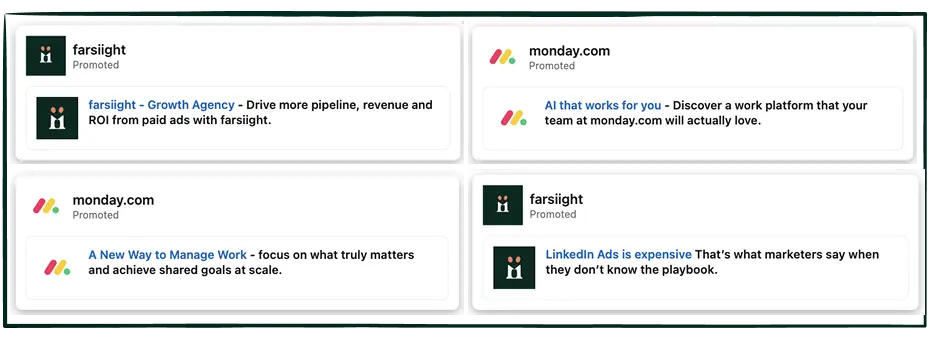
LinkedIn text ads
Nugget that matters: Text ads are click-based. In practice, that means you get a lot of unpaid exposure alongside a very small number of paid interactions. It’s one of the easiest ways to stay visible to your ICP with minimal incremental cost.
Do this this week: take your homepage headline (or your strongest POV line) and turn it into two text ads. Run them always-on to your ICP while your other formats do the heavier lifting.
What to measure: ICP reach and frequency.
LinkedIn Single Image Ads
Where it sits: top to mid funnel.
Placement: Feed
What it’s for: landing a single idea quickly.
What it’s not for: explaining complexity.
Single image ads work when they stop the scroll long enough to land one clear message – a pain, a belief, or a point of view. They’re not designed to educate or convert on their own.
You might be thinking: “But thought leaders post single images with lots of text all the time, and it seems to work.”
While that’s true, the dynamic is fundamentally different.
In thought leader posts, the image isn’t the hook, the person is. People stop because they recognise the name, trust the point of view, and expect something valuable. The image functions more like a slide in a presentation than an ad.
Company pages don’t have that same pre-earned attention.
The image has to do the work on its own. That’s why clarity beats density. When attention is fragile, asking someone to read and process too much too quickly usually loses them.
For brands, single-image ads are most effective when they:
- land one sharp idea
- make a clear statement
- create familiarity or positioning, not explanation
If the goal is education, nuance, or depth, other formats do the job better.
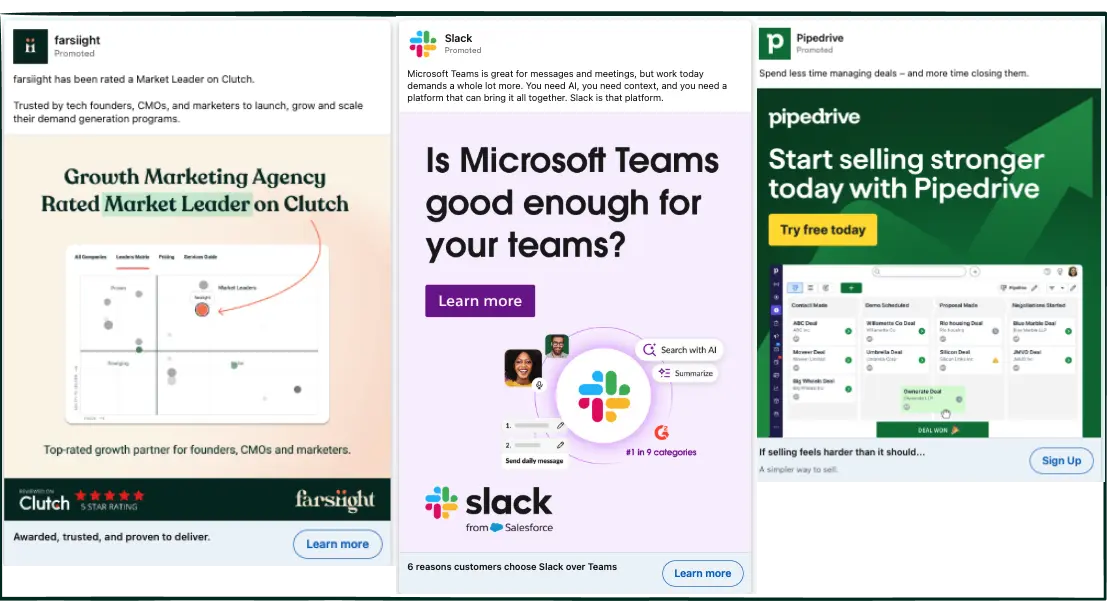
LinkedIn Single Image Ads
Nugget that matters: if you can’t summarise the idea in one sentence, it doesn’t belong in a single image ad.
Do this this week: take one buyer pain you hear repeatedly on sales calls and turn it into a blunt headline-led image. Run it to cold ICP, then retarget engagers with a document or carousel that adds more depth.
What to measure: engagement quality and reach across target accounts, not conversions.
LinkedIn Carousel Ads
Where it sits: mid funnel.
Placement: feed
What it’s for: walking someone through an argument, one card at a time.
Carousels are the only in-feed format that lets you control sequence. A single image lands one idea; a video demands sustained attention. A carousel does something different — it lets you build a case where each card has to earn the swipe to the next. That’s the whole skill, and it’s why most carousels underperform: teams treat them as a container for content they already had (chop a blog into eight cards) rather than as a single argument that only makes sense in order.
Strong carousel angles all share that sequential logic:
- Reframing a common belief (what most teams think vs what actually works)
- Explaining a better model (old approach → its limits → better way of thinking)
- Breaking a single framework into its component parts
- Showing cause and effect (do X, and here’s what happens over time)
- Surfacing a blind spot (the thing teams don’t realise they’re optimising for)
They fail when they become mini slide decks. Dense copy doesn’t educate in-feed, it just lowers completion. And the most common own-goal is wasting card one on a branded cover slide — card one isn’t a title, it’s the hook. If it doesn’t make someone want card two, nothing after it matters.
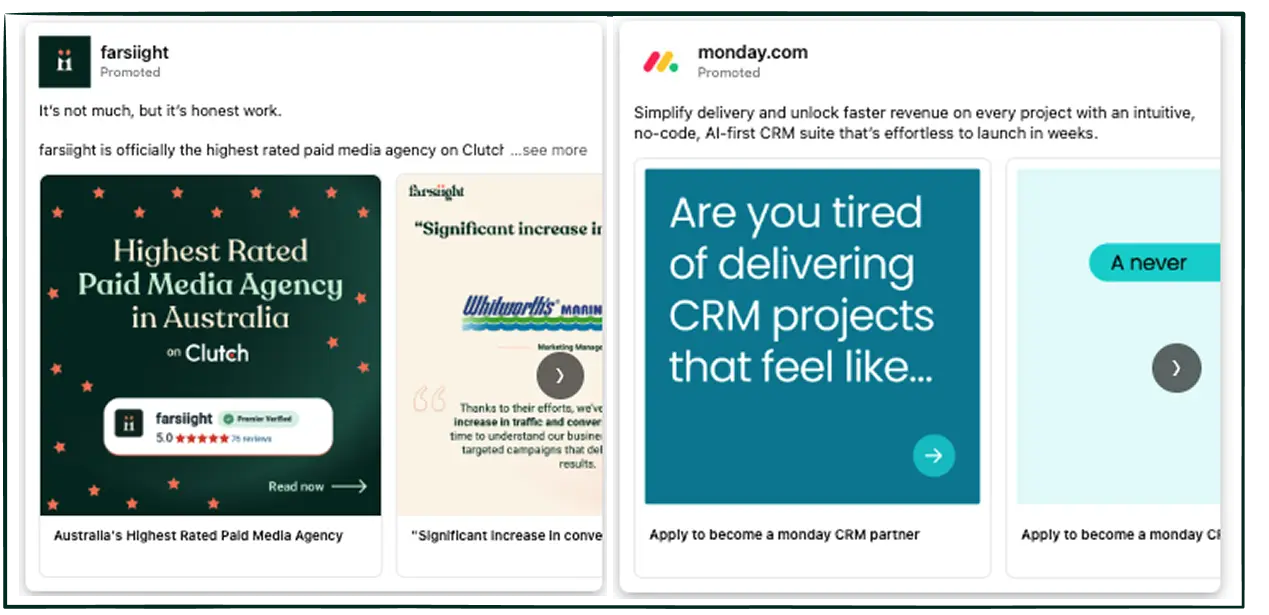
LinkedIn Carousel Ads
Nugget that matters: completion rate isn’t a vanity metric here, it’s a diagnostic. A drop-off tells you which card broke the logic, so you fix the argument, not the design.
Do this this week: take one internal framework you already use and rebuild it as 6–8 cards, one idea per card, written so each card sets up the next. No cover slide.
What to measure: completion rate, and where in the sequence people drop.
LinkedIn Video Ads
Where it sits: mid funnel.
Placement: Feed
What it’s for: building trust and credibility quickly.
What it’s not for: long brand stories or feature demos.
Video’s real job on LinkedIn isn’t information, it’s evidence of a person. Static formats can claim expertise but video demonstrates it, through tone, fluency, and how someone handles a nuance live. That’s why a founder or expert talking to camera consistently beats a produced brand video. Production signals “marketing.” A person talking signals “this is someone who actually does the work.” The polish you think you’re buying is often the thing costing you trust.
The bigger mistake is sequencing. Video should be the second thing a message does, not the first. Validate the angle cheaply, a text ad, a single image, an organic post, and only commit production budget once you know the idea earns attention. Most teams invert this and spend their largest production budget on their least-validated idea, then wonder why an expensive video flopped.
One technical point that decides everything: LinkedIn video autoplays silent. Your hook isn’t a spoken intro, it’s the on-screen text in the first frame and the first second of motion. If the point isn’t landing before someone’s thumb keeps moving, the rest of the video doesn’t exist.
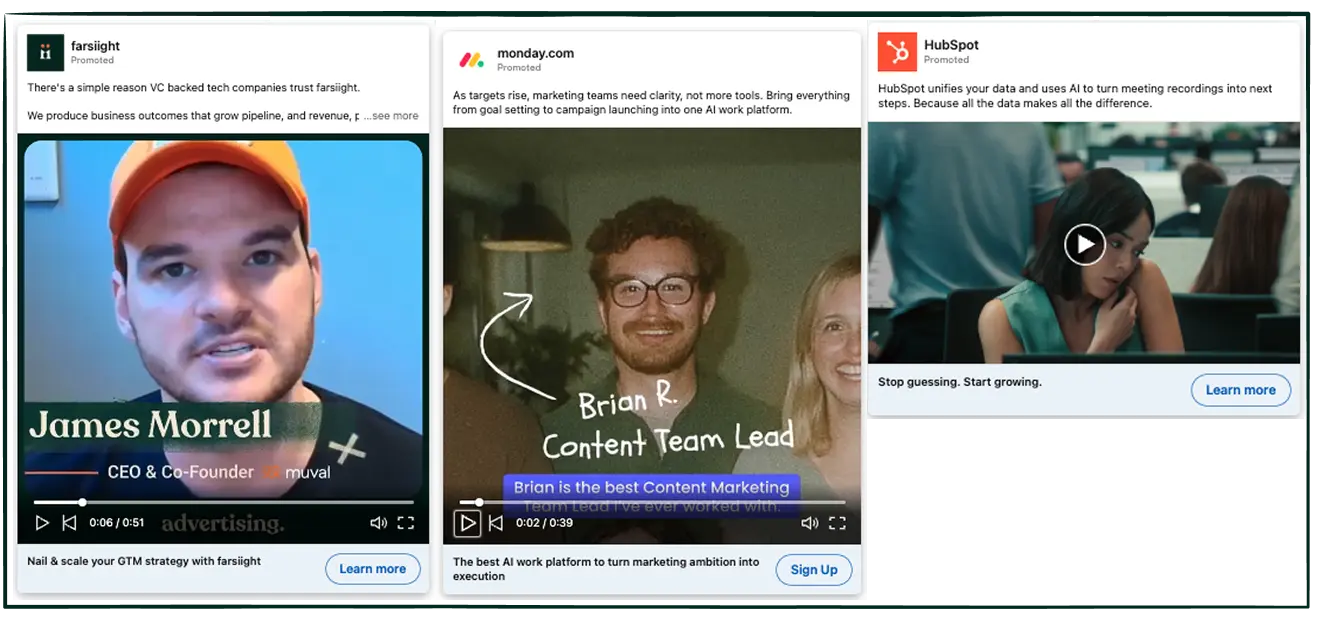
LinkedIn Video Ads
Nugget that matters: lead with the conclusion, on screen, in the first frame. Earn attention first, then give context.
Do this this week: record one 30–45 second clip answering a question buyers always ask (pricing, attribution, lead quality, why LinkedIn is “expensive”). Burn in captions, open on the answer, then retarget viewers with a document ad that expands it.
What to measure: hold rate and view-through to the key point first, not conversions. Judge a trust-building format on leads and you’ll kill it before it works.
LinkedIn Connected TV (CTV) Ads
Where it sits: top of funnel.
What it’s for: broad, high-impact awareness across buying groups.
What it’s not for: targeting precision, education, or performance-led outcomes.
LinkedIn CTV ads are essentially brand video placements delivered via streaming TV environments, with LinkedIn’s B2B targeting layered over the top. They’re designed to reach senior decision-makers outside the LinkedIn feed, in a lean-back context.
That context matters.
CTV is not a discovery or education format. You don’t have attention for nuance, and you don’t have an immediate action available. The job here is to make your brand feel familiar before buyers ever engage with you directly.
Where teams go wrong is trying to treat CTV like a scaled LinkedIn video ad. Longer explanations, product messaging, or conversion thinking don’t translate to a TV environment. If the message isn’t instantly clear, it’s lost.
CTV also only makes sense once you already know what message you want to land. It’s not a testing channel. It’s an amplification channel.
Nugget that matters: CTV is supposed to cost more. You’re not buying performance, you’re buying recognition. If the message isn’t simple enough to land in a few seconds, the CPM premium won’t pay back (25-100% higher CPMs than other ad formats.)
Do this this week: don’t rush into CTV. Only consider once you’ve validated a positioning or pain point through in-feed formats. Use a short, simple video that reinforces one idea, then let LinkedIn formats do the follow-up work later.
What to measure: reach across target accounts, frequency, and lift in downstream performance of other formats. If you judge CTV on direct response, you’ll turn it off before it has a chance to work.
LinkedIn Document Ads
Where it sits: mid funnel, often the bridge between awareness and intent.
What it’s for: education and POV distribution in-feed.
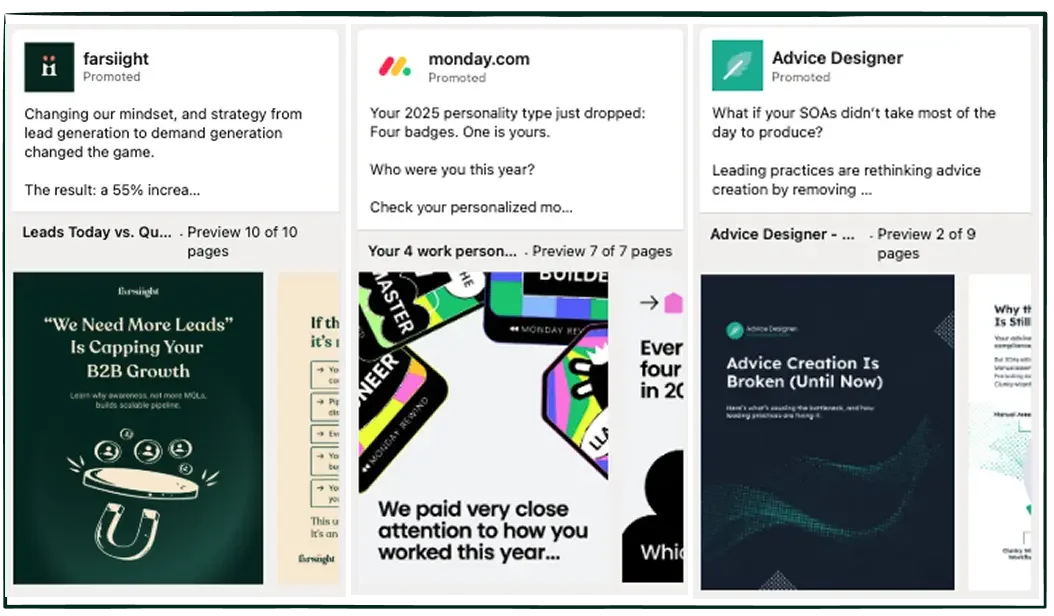
Document ads are one of the best ways to teach buyers before they’re ready to convert. They let you show your thinking without forcing a website visit.
They’re also misunderstood because “document” gets treated like “lead magnet”. Sometimes gating can work (far less these days), but the format is strongest when it’s useful even if someone never becomes a lead.
LinkedIn’s own resources position document ads as promoting documents directly in feed, where people can read and download without leaving the platform.
LinkedIn Document Ads
Nugget that matters: one idea per page. If page 1 isn’t strong, nothing else gets read.
Do this this week: take your best-performing blog post and turn it into a 7–10 page document: hook, 3–5 key points, simple framework, one example, clean CTA.
What to measure: opens and progression (how far people get)
Thought Leader Ads
Where it sits: top to mid funnel.
What it’s for: scaling posts from real people to build trust.
What it’s not for: brand messaging dressed up as personal content.
Thought Leader Ads work because they borrow trust. People engage with people long before they engage with brands, especially in B2B, where buyers are sceptical, overloaded, and rarely “in market” at any given moment.
This is why Thought Leader Ads consistently outperform brand-led formats at the top of the funnel. They don’t feel like ads. They feel like insight.
LinkedIn positions Thought Leader Ads as a way to promote organic posts from individuals via Sponsored Content, and that framing matters. The format only works if the underlying post stands on its own. Promotion doesn’t create relevance; it only scales what’s already there.
So you can essentially use organic as a way to validate a post without ever paying for it. How good is that?
The biggest mistake teams make is promoting posts that are fine. Safe opinions. Vague encouragement. Content written to appeal to peers rather than buyers. When that happens, amplification just buys more people scrolling past.
Where Thought Leader Ads really shine is when the content is grounded in real buyer pain.
At farsiight, we don’t start Thought Leader content with “what should we post?”. We start with what buyers are already telling us. Discovery notes. Sales calls. Objections. Confusion. Friction. The language prospects use when they’re frustrated or sceptical.
That’s the raw material.
When a Thought Leader post reflects a pain buyers recognise instantly, something they’ve experienced but haven’t articulated, it earns attention. Promotion then becomes leverage, not rescue.
LinkedIn Thought Leader Ads
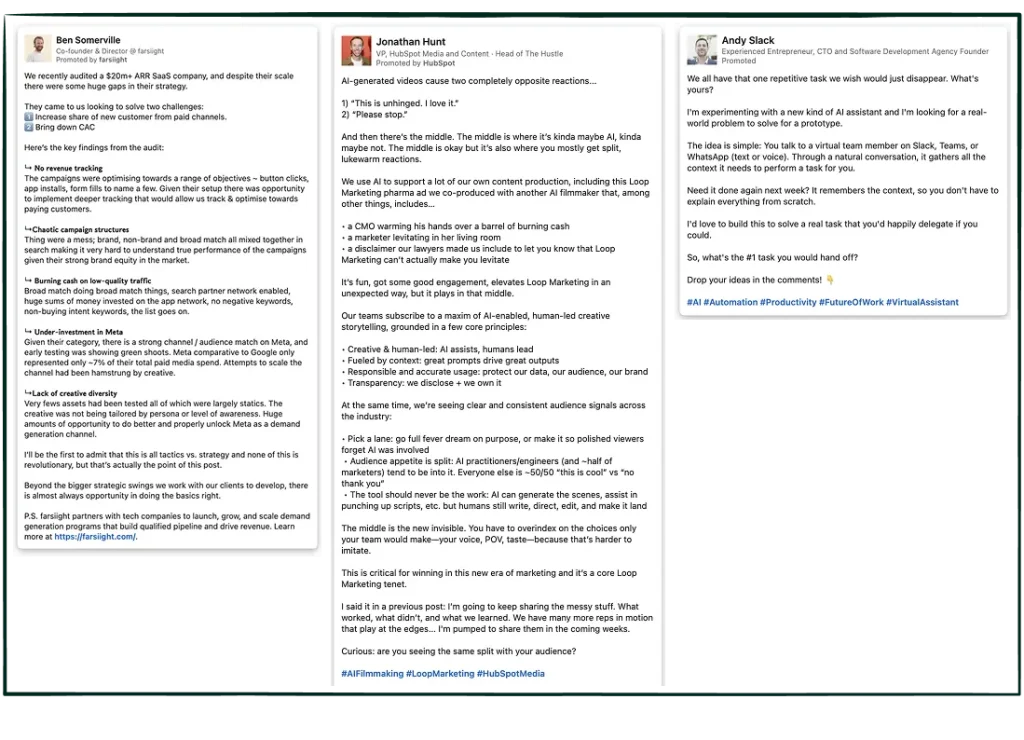
Nugget that matters: the first ~200 characters do all the work. Your hook needs to land before the “see more” cut-off, with a clear stance that makes buyers think “that’s exactly our problem.” If the post doesn’t earn attention in those opening lines, promotion just scales indifference.
Do this this week: take three common pain points from recent calls, recent reviews, or from deep research. Write one post that tackles just one of them with a clear stance: what most teams get wrong, why it keeps happening, and what to do instead. Open strong, stay specific, and end with one practical takeaway.
What to measure: engagement quality first, comments, saves, profile clicks, then downstream signals like site visits, demo page views, and retargeting performance. CTR alone misses the point.
LinkedIn Sponsored Messaging (Message Ads & Conversation Ads)
Where it sits: mid → bottom funnel, best as retargeting or warm outreach.
What it’s for: prompting a next step when context already exists.
What it’s not for: cold demand generation or multi-step nurturing.
Sponsored Messaging is powerful when it’s not cold. If someone has already engaged with you, a message can feel like a helpful nudge. If they haven’t, it usually feels like spam.
This format assumes recognition.
The recipient should already know who you are, what you do, and roughly why the message might be relevant. When that context is missing, performance drops quickly, and brand trust takes a hit.
That’s why Sponsored Messaging works best after other formats have done their job. It’s not here to explain, persuade, or educate. It’s here to point someone to a next step they’re already primed for.
Another constraint most teams overlook is that you don’t get many shots. Sponsored Messages are frequency-capped, which means you can’t rely on repetition to make something land. Each message needs to earn its place in the inbox.
This is also why long copy and multi-step thinking fails here. The inbox is a high-friction environment. The more you ask someone to read, consider, or choose, the less likely they are to act.
LinkedIn Conversation Ads
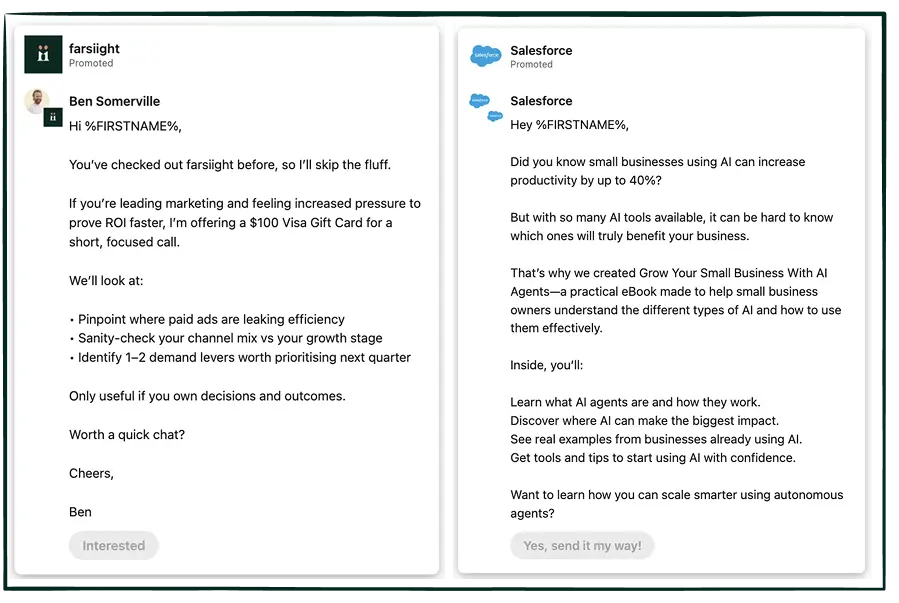
Nugget that matters: treat Sponsored Messaging like a nudge, not a nurture sequence. One message. One idea. One clear outcome.
Do this this week: build a warm audience based on prior engagement (document openers, video viewers, page engagers). Send a short message that points to a single, relevant asset, a benchmark, checklist, short guide, webinar or even offer. Make the relevance obvious in the first line and the action obvious at the end.
What to measure: downstream behaviour like asset consumption, replies, conversions.
LinkedIn Lead Gen Forms
Where it sits: bottom funnel.
What it’s for: removing friction when intent already exists.
What it’s not for: creating demand or qualifying uninterested buyers.
Lead Gen Forms can work extremely well when the offer matches readiness: demo requests, event registrations, assessments, pricing guides, or “get the template” style assets.
Where teams get burned is using Lead Gen at cold audiences with a weak offer, then celebrating volume and wondering why pipeline quality tanks. The form makes it easy to raise a hand, but it doesn’t make someone want to.
It’s also worth remembering that chargeable events and “click behaviour” vary by objective and setup. LinkedIn documents this explicitly, which means performance comparisons only make sense when the objective matches the job you’re asking the format to do.
Nugget that matters: the form isn’t the offer. The offer is the offer.
Do this this week: take your strongest bottom-funnel asset (or create a short one) and run Lead Gen only to warm audiences first. Earn the right to go cold later.
What to measure: lead-to-SQL rate (or whatever your first quality gate is), not CPL as this can often be low depending on what the offer is.
Event Ads, Article/Newsletter Ads
Where it sits: mid funnel.
What it’s for: amplifying content that already earns attention.
What it’s not for: rescuing weak content or manufacturing interest.
These formats are distribution, not creation. They don’t change the quality of the underlying asset, they change how widely it travels. So the question they answer isn’t “what ad should we make?” It’s “what already earned attention organically that deserves a bigger audience?” Used well, they let you stop building bespoke ad assets and start systematically amplifying your best work.
The two behave differently enough to treat separately, though:
Event Ads fail on timing and temperature, not creative. Webinars die when you promote registration cold and late. The ad fills seats, just not with the people you want. Promote to warm audiences who already know you and the format compounds; promote to cold, and you’re paying for no-shows.
Article and Newsletter Ads are quietly the most underrated of the set, because a newsletter subscription is a recurring, owned-ish touchpoint, not a one-off impression. That reframes them from “content amplification” to audience-building. The metric that matters isn’t the click, it’s subscriber growth within your target accounts, because that’s a list you get to talk to again for free.
Nugget that matters: sponsor to the accounts you actually want buying from you, not a broad audience hoping something sticks. Reach without relevance is just spend.
Do this this week: if you’re running a webinar, promote it with Event Ads to warm audiences only. If you publish strong POV content or a newsletter, sponsor it to your target account list and track how many of them subscribe.
What the best B2B teams do differently
High-performing B2B teams don’t win on LinkedIn Ads by using more formats or more sophisticated creative. They win by being disciplined about what each format is allowed to do.
A few patterns show up consistently.
- They don’t try to convert from every ad.
Top-of-funnel formats are allowed to build familiarity. Mid-funnel formats are allowed to educate. Bottom-funnel formats are only used once intent already exists. This separation is what allows performance to compound over time. - They repeat messages longer than feels comfortable.
Instead of constantly rotating creative like you have to do on Meta, they let a small number of clear ideas saturate their ICP. Familiarity with a more defined audience is built through consistency. - They separate education from capture.
Content that teaches or reframes a problem isn’t forced to generate leads. Conversion is treated as a next step, not a requirement placed on every interaction. - They use people to earn trust before brands try to earn clicks.
Senior voices and subject-matter experts do the early work. Brand ads follow once credibility has been established.
| Funnel stage | The job of the format | Formats that fit |
|---|---|---|
| Top | Build familiarity and recognition with the right accounts | Text Ads, Single Image Ads, Connected TV, Thought Leader Ads |
| Mid | Educate buyers and shape how they think about the problem | Carousel Ads, Video Ads, Document Ads, Thought Leader Ads, Event / Article / Newsletter Ads |
| Bottom | Capture intent that already exists | Lead Gen Forms, Sponsored Messaging (Conversation & Message Ads) |
Final thought
LinkedIn doesn’t fail because the platform is expensive or saturated. A big reason it fails when every format is forced to behave like a conversion lever.
The teams that win are clear on roles. They let some formats build familiarity, others shape thinking, and only a few do the job of capturing demand. When each format is judged against the role it’s meant to play, performance starts to compound instead of stall.
If your LinkedIn account feels busy but not effective, the issue usually isn’t creative or targeting. It’s sequencing, expectations, and measurement.
If you want a second set of eyes on how your formats are being used, and whether they’re doing the job they should, that’s exactly what we help B2B teams untangle at farsiight.
FAQs
There isn’t one “best”. The best format depends on buyer readiness. Text, image and thought leader ads are strong for familiarity, document/carousel/video are strong for education, and lead gen + sponsored messaging are strongest for capturing existing intent. If we had to pick four ad formats only, we'd choose thought leader, image, document and conversation ads to leverage the full-funnel.
Most formats can sit in multiple stages, but they each assume a certain readiness level. The biggest mistake we see with ad format useage is trying to use bottom-funnel formats like lead gen and conversation ads to create demand.
LinkedIn places frequency limitations to prevent fatigue. Guidance notes members only receive the same message ad once every 45 days, and conversation ad best practice guidance references the same cap concept.



Josh Somerville
Josh is our Director at farsiight, with over 15+ years experience in B2B.
Like what you read?
Learn more about digital, creative and platform strategies below.