

The 6 LinkedIn Ads Landmines Silently Killing Your B2B Pipeline
In this article, we break down the hidden traps inside LinkedIn’s ad platform, why they happen, and how high-performing B2B teams avoid them to drive stronger efficiency, higher-quality demand, and cleaner reporting.
If you’re a B2B marketing leader investing in LinkedIn Ads, you hopefully already know the platform is powerful.
Unmatched targeting, deep professional context, and the ability to get in front of buyers well before they enter the market.
But: most B2B companies are quietly blowing up their own LinkedIn Ads performance without realising it.
Not because they don’t have product-market fit.
Not because the creative is weak.
But because of hidden platform settings that drain thousands in budget every single month.
These landmines don’t show up in your weekly dashboards. They don’t appear in your pipeline reports. And they definitely don’t get flagged by LinkedIn’s algorithm.
But they are silently killing your pipeline.
Below are the six biggest LinkedIn Ads landmines we see across B2B accounts, and exactly how to defuse them to protect your budget, improve targeting accuracy, and start to turn spend into influenced pipeline.
Landmine #1 — LinkedIn Audience Network: The “extra reach” that reaches nobody you care about
The “extra reach” that reaches nobody you care about.
The LinkedIn Audience Network takes your ads off LinkedIn and shows them across third-party websites and mobile apps. It’s pitched as a scalable way to increase reach, but the reality is that it drags your B2B ads into low-intent consumer environments where professional context doesn’t exist.
The result?
Low-quality traffic, inflated impressions, and ad dollars drifting into placements that have nothing to do with your ICP.
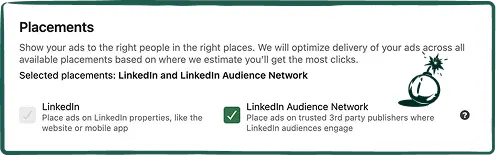
Turn it off.
You’re paying LinkedIn prices; keep your ads inside LinkedIn’s ecosystem where the buying committee actually pays attention.
Landmine #2 — Relying solely on LinkedIn’s native company targeting
Good, but far from precise enough for real ABM.
LinkedIn’s firmographic data is solid, but “solid” isn’t good enough when you’re targeting highly specific B2B segments. Headcount bands can be outdated. Revenue labels can be wrong. Company attributes lag behind real-world changes.
That’s why relying on native filters alone often creates audience drift.
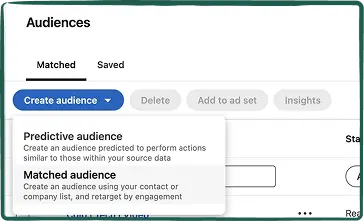
Fix it: Build your own ABM/company lists and upload them via Company Match.
This gives you:
- Clean, verified ICP data
- Better match accuracy
- Stronger alignment with sales
- Higher confidence in who you’re actually reaching
The smartest B2B marketers treat LinkedIn’s native filters as a layer, not the source of truth.
Landmine #3 — Audience Expansion
A helpful feature… for people who are optimising for cheap clicks.
Audience Expansion automatically adds “similar” users to broaden reach, but LinkedIn’s similarity modelling for niche B2B audiences is notoriously loose.
It often expands you into:
- Junior roles
- Irrelevant job functions
- Entire countries you don’t sell into
- People you would never put in an ICP list
It’s framed as efficiency.
But for B2B, it’s a relevancy killer.
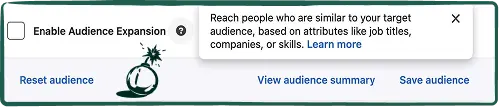
Turn it off.
You don’t need similar, you need exactly your ICP.
H2: Landmine #4 — Maximum Delivery
Maximum Delivery = Maximum Waste
Maximum Delivery is LinkedIn’s automated bidding option where the platform takes full control of how much you pay per impression or click. Its goal is simple: spend your daily budget in full, every day, even if that means aggressively overbidding in auctions. LinkedIn prioritises spending your money rather than spending it efficiently, which leads to inflated CPMs and CPCs, especially in competitive B2B segments.
What actually happens:
- CPMs climb
- CPCs inflate
- Delivery becomes unstable
- You pay a “convenience tax” you never approved

Switch to Manual Bidding.
It’s common to see 20–40% cost savings immediately if coming from a max delivery setting.
Landmine #5 — Not setting company-level impression caps
Your largest accounts are stealing your budget, and not because they’re engaged.
This is the most quietly destructive landmine for ABM campaigns.
LinkedIn’s algorithm over-delivers to large companies because:
- They have more employees
- They have more ad inventory
- They make delivery easier for the system
But this creates a false signal:
Big companies look “more engaged” simply because they’re being hammered with impressions.
Meanwhile, smaller but highly valuable ICP accounts barely see you.
LinkedIn doesn’t offer impression caps, so without external control, you lose distribution quality across your account list.
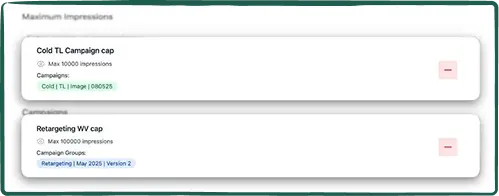
Fix it: Use tools like Fibbler to set company-level caps and balance frequency.
It changes everything, especially for mid-market and enterprise targeting.
Landmine #6 — Focusing solely on lead generation
Optimising for form fills and cheap clicks and not awareness means you’re only catering to the 5% that are in market.
The classic B2B trap:
Spend heavily on gated PDFs and “Book a demo” CTAs, google search, then wonder why CAC blows out and sales complain about low-quality leads.
Here’s the truth:
B2B buyers don’t want to be sold early. They want to understand the problem, the category, and the solution first.
LinkedIn is most powerful as a demand generation engine, not a lead-gen machine.
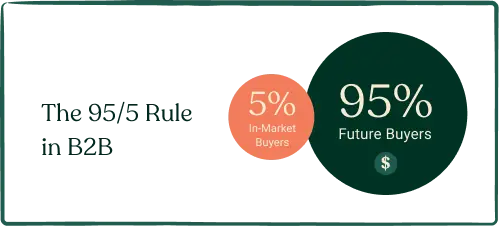
Use it to:
- Educate your market
- Build mental availability
- Warm accounts months before intent shows up
- Influence the buying committee long before a form fill
Pipeline grows when you win the mindshare long before the click.
Stop burning budget. Start building pipeline.
Most B2B marketers aren’t struggling because their strategy is wrong.
They’re struggling because LinkedIn quietly misallocates budget behind the scenes, and nobody tells them.
If you want help reviewing your account or building a high-performance LinkedIn strategy, we’d love to support you.
FAQs
Maximum Delivery pushes impressions toward the cheapest people in your audience, not the most qualified. This often leads to wasted spend, inflated CPLs, and lower-quality pipeline. Manual bidding gives stronger control and efficiency.
Yes, for most B2B campaigns. Both features broaden your reach beyond your ICP, making your ads appear in placements and profiles that don’t match your targeting. This weakens relevancy and lowers lead quality.
Refreshing creative on LinkedIn Ads isn’t just a timing exercise, it’s driven by how quickly your campaigns saturate your ideal B2B audience. The two biggest drivers of creative fatigue on LinkedIn are TAM size and budget, because both determine how fast your ad frequency climbs. If your TAM is small (for example, 5k–25k senior decision-makers), your ads reach the same people very quickly. A moderate or high budget accelerates this even further, pushing frequency into the fatigue zone within 2–4 weeks. This is where CPMs rise, engagement drops, and lead quality weakens because your ICP has already seen the creative multiple times. With a mid-sized TAM (50k–150k), you get more room before fatigue sets in. Frequency builds at a sustainable pace, making 4–6 weeks the typical refresh cycle for most B2B companies running LinkedIn Ads. For large TAMs (200k+), the platform can distribute impressions more evenly, even when budgets are strong. In these scenarios, creative can perform well for 6–8+ weeks, especially video content, which fatigues more slowly than static images. Budget is the accelerator in all of this. High daily budgets against small or mid-sized audiences cause frequency to spike rapidly. Lower budgets slow fatigue but also delay learning and optimisation. For B2B marketers running LinkedIn Ads, the simplest rule is to refresh creative when frequency reaches 6–8 for cold audiences, 3–5 for warm, and 1.5–2 for remarketing. TAM size determines how quickly frequency increases, and budget determines how aggressively you hit that limit. This approach ensures your LinkedIn Ads stay efficient, protect CPMs, and keep your message resonating with the exact accounts you want to influence.


Ben Somerville
Ben is our Director at farsiight, with over 15+ years experience in B2B.
Like what you read?
Learn more about digital, creative and platform strategies below.